A Bargain, At What Cost? Is it ok to shop at SHEIN and Temu?
Does paying more buy you better quality and better practices? Or sometimes just better marketing?
A $7 dress. A $3 necklace. A bag of chip clips for $1.19?!
An entire cart for less than the price of one sweater somewhere else, and you get 45 items.
It’s easy to understand the appeal of SHEIN and Temu. But for me—and many people who have shopped on these sites— the excitement of buying is usually met with uneasiness and confusion.
You’ve probably heard concerns about working conditions, environmental damage, and product safety covered by the media. At the same time, you might wonder, how much better are the brands charging five—or fifty—times more?
For anyone trying to shop thoughtfully on a budget, the advice can feel frustratingly simple: buy fewer, better things. Reasonable enough—until “better” is hard to verify and costs more than you can afford.
So, is it okay to shop at SHEIN and Temu?
To make sense of this, it helps to separate three questions: What are the companies doing? What are we actually buying? And what choices do we, as shoppers, realistically have?
The companies: What does the low price leave out?
SHEIN and Temu work a little differently. SHEIN sells its own clothing brands as well as products from other sellers. Temu mainly connects shoppers with sellers offering everything from clothes to electronics. [1, 2] That means a finding about a SHEIN factory doesn’t automatically tell us how a Temu product was made.
Still, both companies face serious questions about the people making the products they sell.
H3 What about those “help me” notes?
You might remember videos of shoppers finding what appeared to be cries for help on clothing labels or inside packages. Those stories are hard to forget—but the widely shared claims about SHEIN weren’t backed by evidence. [3]
Fact-checkers found that some images showed poorly translated washing instructions or a product label mistaken for a distress message. Others weren’t connected to SHEIN at all. [3]
Similar stories have involved other retailers. In 2014, a shopper reported finding a note describing forced prison labor inside trousers bought at Primark. Amnesty International shared the allegation but cautioned that it was difficult to confirm whether the note was genuine. [4]
We don’t need an unverified note to take working conditions seriously.
In a 2024 investigation, the Swiss organization Public Eye interviewed workers at factories supplying SHEIN who reported working around 75 hours a week. Workers were paid by the piece, meaning their earnings depended on how many items they completed. [5] These interviews don’t tell us what happens in every factory, but they provide direct accounts of long hours and demanding conditions.
SHEIN has disputed that picture. It points to outside wage research, rules for suppliers, and investments in better factories. [6] The company also reported more than 4,000 on-site checks of suppliers and subcontractors in China during 2024. [7] Those efforts matter, but rules and inspections need to lead to better conditions in workers’ daily lives.
For Temu, a key concern is whether it knows enough about where its marketplace products come from. A 2023 investigation by a bipartisan U.S. congressional committee raised serious concerns about its systems for keeping goods made with forced labor off the platform. [8]
Temu’s parent company later described steps to screen sellers and policies banning forced and child labor. [2] But having those policies doesn’t tell us how well they protect workers.
The evidence doesn’t show that every SHEIN or Temu product was made under abusive conditions. It does give us reasons for concern: workers have reported excessive hours at SHEIN suppliers, and investigators found serious gaps in Temu’s safeguards against forced labor. Neither company’s promises alone are enough to put those concerns to rest.
The low price raises questions about the people making these products. It also raises questions about the resources used to make them—and what happens after they arrive at our doors.
What does a bargain cost the environment?
Every new piece of clothing has an environmental footprint. Making fabric takes energy and raw materials. Dyeing and finishing it can pollute water. Shipping adds emissions, and washing and disposal create further impacts. [9]
Different fabrics come with different trade-offs. Polyester is made using fossil fuels and can shed tiny plastic fibers. [10] Cotton is a natural fiber, but growing it can put pressure on water supplies. [9] Simply choosing “natural” doesn’t solve every environmental problem.
What also matters is how much we buy—and how long we use it.
A shirt worn regularly for years serves a different purpose from one bought for a single photo and then forgotten. Yet much of the fashion industry depends on a steady stream of new products and reasons to replace what we already own. UNEP identifies overproduction, overconsumption, and waste as central problems in the industry. [11]
SHEIN says it is working to reduce its impact through more efficient production, renewable energy, and recycled materials. [7] It also promotes a model that starts with small batches and makes more when an item sells. [12] That can help limit unsold stock, but it doesn’t answer the larger question of how much clothing the company produces overall. Less unsold clothing and less clothing produced are two different achievements.
The shopping experience matters here, too. When an app keeps offering discounts, countdowns, and rewards, buying one thing can quickly turn into buying ten. European consumer organization BEUC has documented techniques on SHEIN that it argues pressure shoppers into unwanted purchases and encourage overconsumption. [13]
For shoppers, that makes one question especially useful: Would I still want this if there were no sale, no timer, and no reward for adding more to my cart?
These concerns extend beyond SHEIN and Temu. The wider fashion industry also relies heavily on newness and frequent purchases. Switching to a more expensive retailer won’t necessarily reduce our impact if we keep buying just as much and wearing it just as little. Keeping clothing in use for longer is one practical way to reduce the need for new production. [14]
A low price doesn’t tell us the environmental cost of an individual item. But when it encourages us to buy things we barely use, the bargain comes with a cost that never appears at checkout.
The products: Is cheap always worse?
This is where the conversation gets surprising.
University of Leeds researchers found that price did not reliably predict clothing durability. In their testing, both inexpensive and expensive garments ranged from excellent to poor. [15]
In a later study of 47 T-shirts, a £395 shirt ranked 28th for durability, while a £4 shirt ranked 15th. [16]
That doesn’t establish that SHEIN or Temu clothes are durable. It does undermine the idea that spending more automatically buys something that lasts.
“Quality” also covers several different things. A dress might look lovely but shrink. A shirt might survive years of washing but feel uncomfortable. A garment can be durable while having been produced under poor working conditions.
Product safety is (again) another question..
European consumer groups have found restricted chemicals and other compliance problems in sampled products from both platforms. [17, 18] These findings don’t mean every item is unsafe, and targeted tests can’t tell us the failure rate across an entire marketplace. They do provide concrete reasons for concern about oversight.
In May 2026, the European Commission fined Temu €200 million for failing to adequately assess risks from illegal products on its platform. [19] That finding concerned its risk-assessment obligations; it wasn’t a declaration that everything sold there was dangerous.
For shoppers, the frustrating part is that many important qualities are invisible. We can examine a seam. We can’t identify restricted chemicals by looking at a photograph or establish a worker’s pay from the fabric label.
Reviews can help us assess fit and whether an item resembles its pictures. They offer much less reassurance about conditions in the supply chain or compliance with safety requirements.
A good purchase experience and a responsibly made product are different things.
The shopper: What choices do we actually have?
Knowing the problems doesn’t always make shopping decisions easier. We still have budgets, bodies to dress, and limited time to figure out which companies deserve our money.
“Buy something that will last ten years” assumes we can afford it today—and know that it will last. “Just shop secondhand” assumes we can find the right size, style, and condition with the time we have.
Those are useful options when they work. They aren’t equally available to everyone.
People need clothes for work, changing bodies, weather, and everyday life. They also want to enjoy what they wear. Having a limited budget shouldn’t mean losing permission to care about style.
But if we can spend more, does shopping somewhere else actually make a difference?
H3 How do other brands compare?
There are meaningful differences between companies, although a higher price doesn’t guarantee better practices.
Remake’s 2024 Fashion Accountability Report compared brands on environmental and labor issues, including emissions, materials, wages, and supply-chain transparency.
Here’s how some familiar names scored:
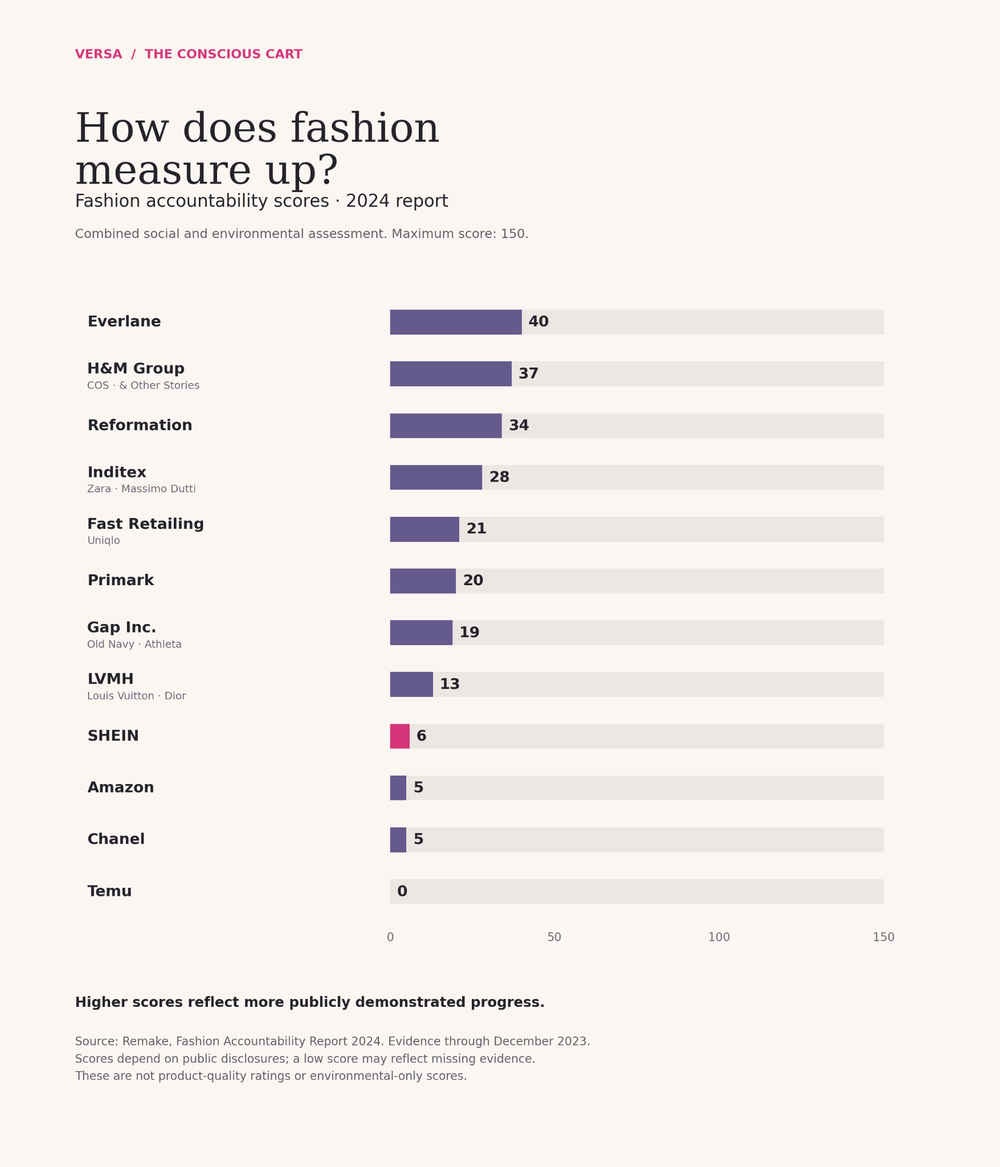
These are combined social and environmental scores—not environmental ratings alone. They reflect public evidence available through December 2023. Low scores can reflect missing disclosures as well as limited demonstrated progress, so they should be read as a dated comparison rather than a current verdict. [20]
Looking specifically at environmental progress, the report credited H&M Group, Everlane, and Burberry with publishing full emissions figures, setting independently approved climate targets, and demonstrating reductions in total emissions compared with their baseline years. [20] It also recognized repair services at companies including Patagonia, REI, and Burberry. [20] Those are concrete steps, though they don’t erase the impact of producing new clothes.
Companies can also improve after an assessment. SHEIN, for example, subsequently reported approval of its climate targets and investments in energy efficiency and recycling. [7] Targets show an intended direction; tracking total emissions over time helps establish whether those plans are delivering results.
The comparison gives us a more useful approach than assuming “expensive means ethical”: look for evidence of progress, and ask what a brand is actually doing better.
Our own buying habits still matter. Purchasing a few affordable things we need and repeatedly wear is a different decision from ordering a large haul because everything seems too cheap to leave behind.
That makes this a useful question at any price point: Am I using this purchase to meet a need, or is the shopping experience creating the need?
We can take workers and the environment seriously while recognizing that people have different choices available. The aim is to make purchases we can afford, will actually use, and have good reason to feel comfortable supporting.
What can we do with all of this?
Shopping thoughtfully shouldn’t require a research project every time we need a shirt. But a few questions can help us make choices we feel better about:
- Would I want this without the discount or countdown?
- When will I wear it, and will I keep reaching for it?
- What do I know about its quality and safety beyond the reviews?
- Is there another option that works for my budget, size, and time?
Sometimes those questions will lead us to buy secondhand, choose another brand, or keep wearing something we already own. Sometimes an affordable item will be the most practical choice. Either way, pausing gives us a chance to decide whether we want the product or just the deal.
Companies have a bigger job to do. They need to show where their goods come from, how workers are treated, and whether their environmental efforts are reducing their overall impact. Businesses and regulators share responsibility for making sure products meet basic standards. That burden shouldn’t fall entirely on the person buying them.
So, is it okay to shop at SHEIN and Temu?
The evidence gives us good reasons to limit purchases from these platforms and seek alternatives when we can. It also gives us reasons to question the reassuring image of more expensive brands. A higher price alone doesn’t tell us who was paid fairly, what will last, or how much harm was caused along the way.
Our circumstances shape the choices available to us. What we can do is buy with more intention, use what we own for longer, and expect clearer evidence from the companies asking for our money.
A bargain is only useful if it gives us something we actually need or enjoy. The price being low is a reason to consider it, not a reason to buy it.
H2 References and further reading
1. SHEIN Group (2025). 2024 Sustainability and Social Impact Report summary. Distinguishes SHEIN-branded products and the supplier network. https://www.sheingroup.com/newsroom/shein-s-2024-sustainability-and-social-impact-report
2. PDD Holdings. 2023 Annual Report (Form 20-F, filed 2024). Describes Temu’s marketplace and stated labor-compliance policies. https://www.sec.gov/Archives/edgar/data/1737806/000110465924051610/pdd-20231231x20f.htm
3. EFE Verifica (2022). Fact-check of alleged pleas for help on SHEIN labels. https://verifica.efe.com/shein-nada-prueba-trabajadores-pidan-auxilio-mensajes-etiquetas/
4. Amnesty International UK (2014). Report of an alleged prison-labor note found in Primark trousers; authenticity was not established. https://www.amnesty.org.uk/knowledge-hub/all-resources/cry-help-prisoner-chinese-forced-labour-jail-alleged-have-been-found-inside-primark/
5. Public Eye (2024). Interviews with factory employees refute Shein’s promises to make improvements. Findings concern the workplaces investigated. https://www.publiceye.ch/en/topics/fashion/interviews-with-factory-employees-refute-sheins-promises-to-make-improvements
6. SHEIN Group (2024). Response to Public Eye’s investigation. Company statement. https://www.sheingroup.com/newsroom/shein-s-commitment-to-sustainability-and-fair-practices-a-response-to-recent-media-reports
7. SHEIN Group (2025). 2024 Sustainability and Social Impact Report summary. Company-reported audits, environmental initiatives, and target approvals. https://www.sheingroup.com/newsroom/shein-s-2024-sustainability-and-social-impact-report
8. U.S. House Select Committee on the CCP (2023). Interim findings from the SHEIN and Temu forced-labor investigation. Historical findings about compliance safeguards. https://democrats-selectcommitteeontheccp.house.gov/media/press-releases/select-committee-releases-interim-findings-shein-temu-forced-labor
9. UNEP (2020). Sustainability and Circularity in the Textile Value Chain: Global Stocktaking. https://wedocs.unep.org/handle/20.500.11822/34184
10. UNEP. Fashion’s tiny hidden secret. Synthetic textiles and microplastic pollution. https://www.unep.org/en/news-and-stories/story/fashions-tiny-hidden-secret
11. UNEP. Transforming Knowledge: Creating Circular, Socially Conscious Businesses in the Textile Industry. Overproduction, consumption, and circular business models. https://wedocs.unep.org/handle/20.500.11822/48706
12. TIME (2023). A Top Shein Exec on That Influencer Trip Fiasco. Interview explaining the company’s small-batch production claims. https://time.com/6294934/shein-donald-tang-interview/
13. BEUC (2025). Click to buy (more): How fast fashion giant SHEIN uses dark patterns to push overconsumption. Consumer-group research and allegations. https://www.beuc.eu/reports/click-buy-more-how-fast-fashion-giant-shein-uses-dark-patterns-push-overconsumption
14. UNEP (2018). Putting the brakes on fast fashion. Keeping clothing in use for longer. https://www.unep.org/en/news-and-stories/story/putting-brakes-fast-fashion
15. University of Leeds (2023). Why price does not indicate how long clothes will last. Research with Hubbub, supported by Primark. https://www.leeds.ac.uk/main-index/news/article/5346/why-price-does-not-indicate-how-long-clothes-will-last
16. University of Leeds Institute of Textiles and Colour (2025). Price irrelevant when it comes to the durability of your t-shirt. Study of 47 T-shirts. https://litac.leeds.ac.uk/price-durability-study/
17. BEUC (2025). Click to buy (more). Includes member testing of chemicals in SHEIN clothing and accessories. Targeted samples do not establish a marketplace-wide failure rate. https://www.beuc.eu/sites/default/files/publications/BEUC-X-2025-051_How_fast_fashion_giant_SHEIN_uses_dark_patterns.pdf
18. BEUC (2025). Under the Microscope: Tests of Temu Products by Consumer Groups. Includes clothing and other product categories. https://www.beuc.eu/reports/tests-temu-products-by-consumer-groups
19. European Commission (May 28, 2026). Commission fines Temu €200 million for breaching the Digital Services Act. Concerns inadequate assessment of illegal-product risks. https://digital-strategy.ec.europa.eu/en/news/commission-fines-temu-eu200-million-breaching-digital-services-act
20. Remake (2024). Fashion Accountability Report. Combined social and environmental assessment; evidence through December 2023, scores out of 150. https://remake.world/wp-content/uploads/2024/03/Remake-Fashion-Accountability-Report-2024-Updated3.18.24.pdf