Transitioning into Motherhood: The Changes No One Prepares You For
Your identity, emotions, brain, relationships, and body: what shifts, and why it's normal to feel it.
At one of my daughter's first doctor's appointments, the doctor called me "Mom," and I turned to look at my mother-in-law, waiting for her to respond. The doctor laughed awkwardly, and it hit me: Oh! She means me!

Even after nine months of pregnancy, starting with the morning I stared at a positive Clearblue test in shock, the word still hadn't sunk in.
It's not that I hadn't prepared. I prepared the way everyone tells you to. I read the pregnancy books. I learned what to expect from the morning sickness, the aches, and the growing bump. By the time my daughter arrived, I knew how to swaddle (sort of), how often a newborn eats, and which car seat to buy.
What I didn't know was what would happen to me or what had started to happen already.
That moment in the doctor's office was funny. But it was a small sign of something much bigger. Becoming a mother changed how I thought, what I valued, how I felt in my body, and how I related to almost everyone in my life. Almost nothing I'd read had prepared me for it.
So I set out to answer one question: What actually changes when a woman becomes a mother?
The answer starts with a word most of us have never heard.
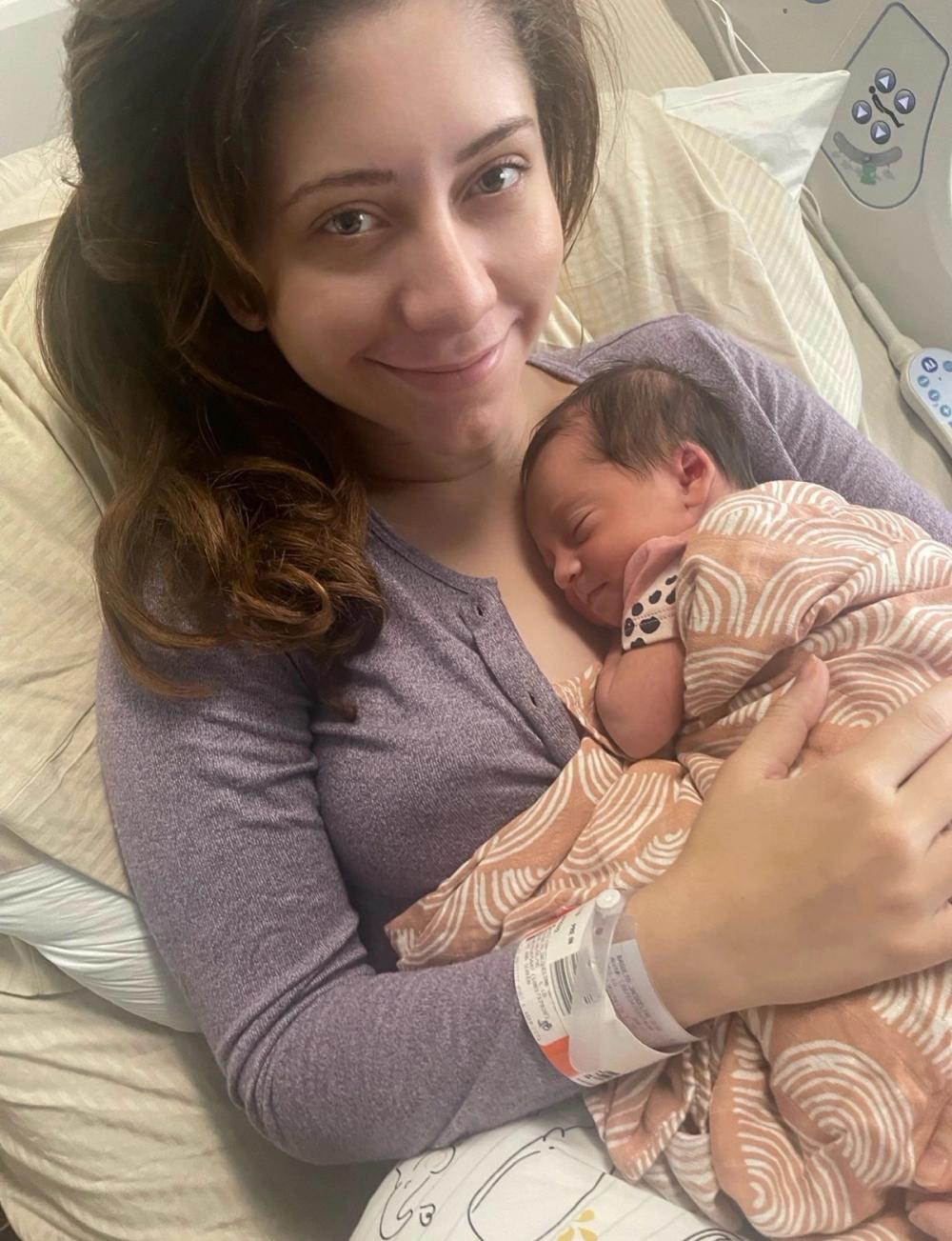
There's a name for this transition: matrescence
In the 1970s, the medical anthropologist Dana Raphael introduced the term matrescence to describe the process of becoming a mother. It covers more than giving birth. It includes the physical, psychological, social, and identity changes that can begin in pregnancy and continue long after. [1]
Matrescence is sometimes compared to adolescence. In both, your body, your relationships, and your sense of self can all shift at once. The comparison isn't perfect, but it helps. Nobody expects a 13-year-old to get through adolescence without feeling a little lost. New mothers deserve the same patience.
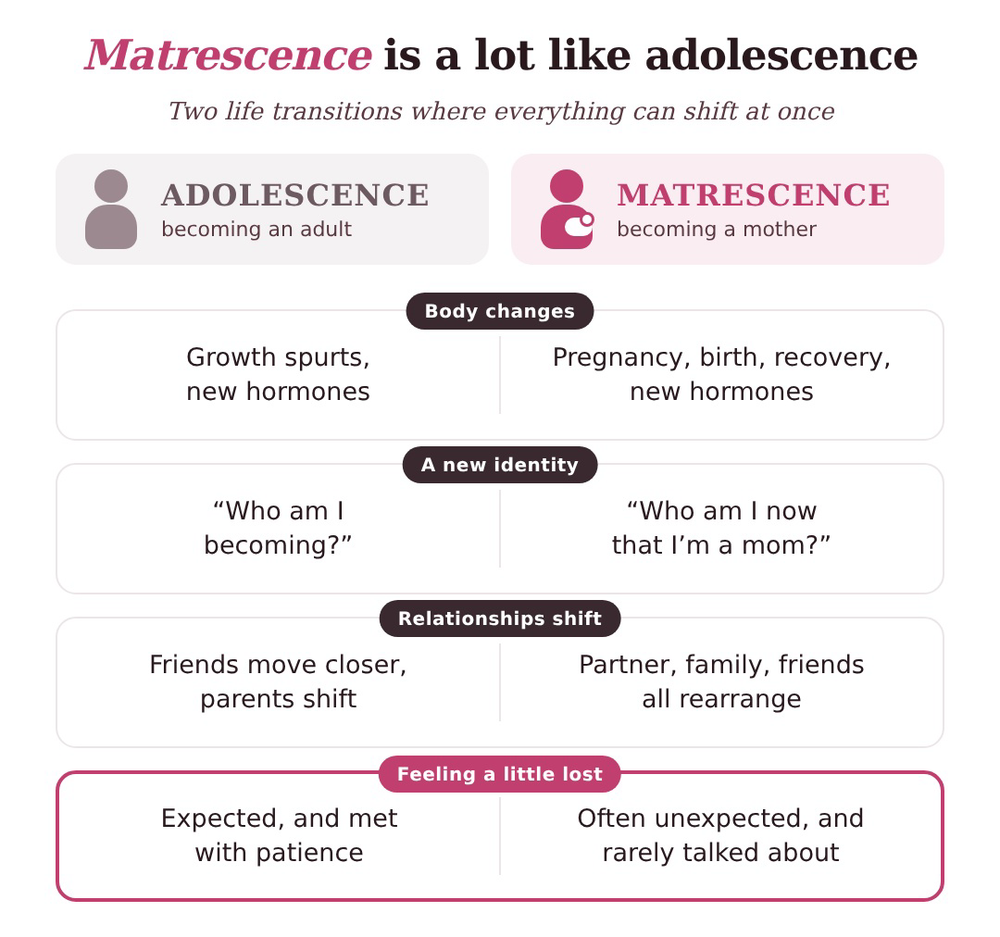
There's no set schedule for when you "should" feel settled. Some women feel deeply changed. Others feel like themselves with a new role. Many feel somewhere in between, and that can change from week to week. Matrescence can continue for years, and the transition can happen again with each child. Learn more about matrescence.
Here are the main areas where those changes tend to show up.
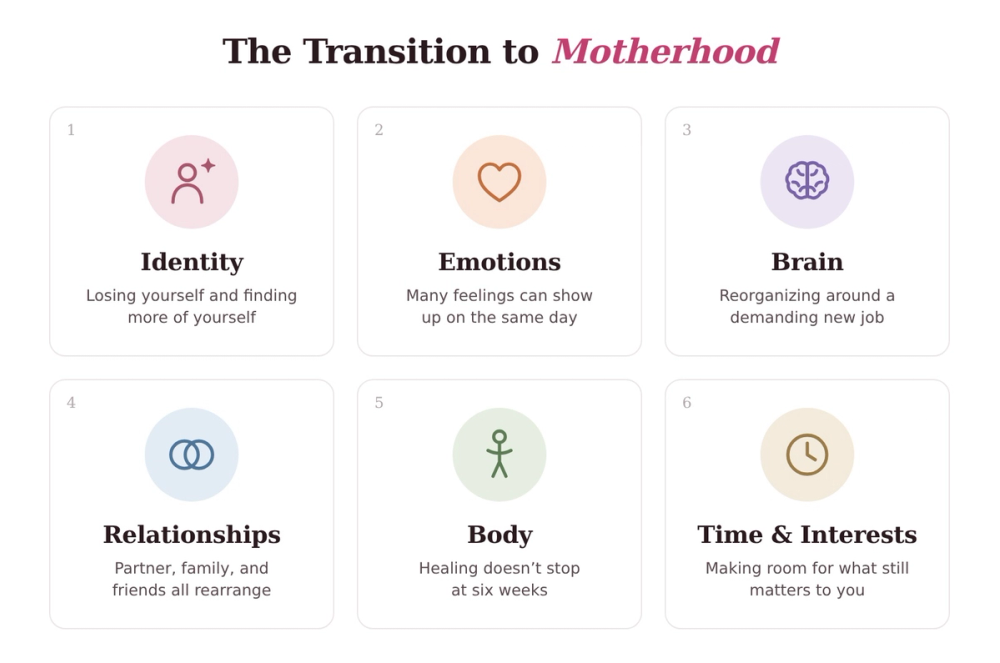
Identity: Losing yourself and finding more of yourself
After my daughter was born, my values shifted in ways I didn't expect. My career and accomplishments used to feel like the most important things I could live up to, and they started to matter less. I, a self-described "fiercely independent" woman, suddenly craved family time and community. I felt content, and at the same time I was scared that I was losing who I used to be.
Research suggests that feeling is common, and that it's not the whole story.
In a study of women's identity development in motherhood, participants described a temporary sense of losing themselves and a growing sense of self as motherhood became part of who they were. Often, both happened as part of the same process. [2]
The study describes some women's experiences, not a path everyone follows. But it offers a more hopeful way to see the confusion. Missing parts of your old life doesn't mean they're gone. You may be making room for something new.
One distinction helped me a lot. Sometimes we stop wanting something. Other times, we just can't see how it fits right now.
"I don't want this anymore" and "I can't see how this could happen right now" are different statements. They deserve different conversations, with yourself and with the people who support you.
Try this: Make two lists. One for things you've truly let go of, and one for things you've only put on pause. The second list is worth coming back to.
Emotions: More than one feeling at a time
Nobody told me I could be completely in love with my daughter and still grieve my old life in the same afternoon.
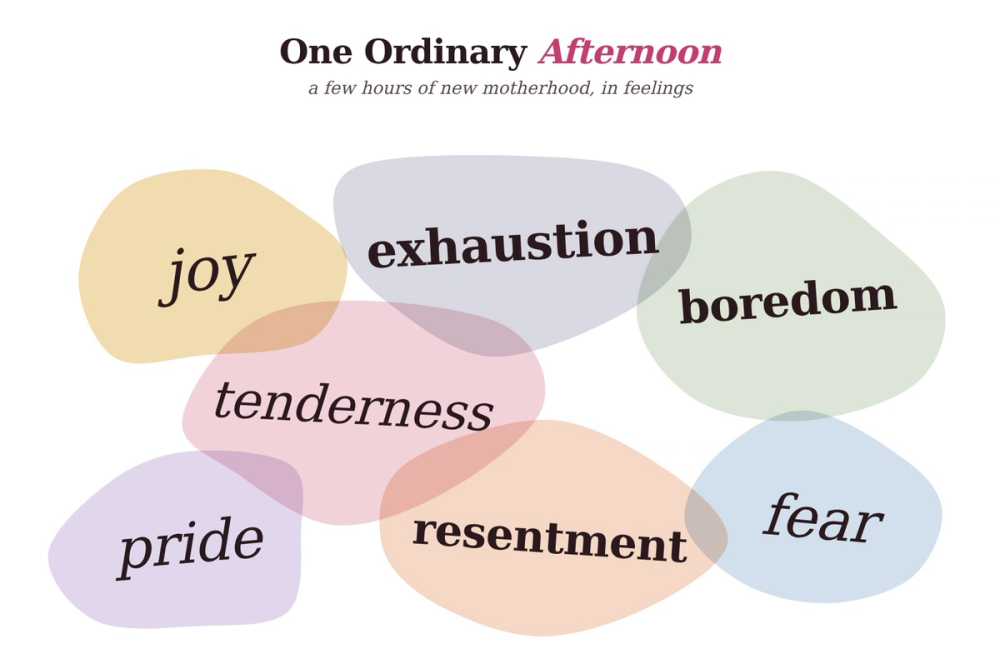
Mixed feelings are one of the most normal parts of new motherhood, and one of the least talked about. Joy, exhaustion, tenderness, boredom, pride, resentment, and fear can all show up on the same day. Feeling all of them doesn't make you ungrateful or a bad mother. It makes you a person going through a huge change.
Some emotional changes are especially common right after birth. The "baby blues" (tearfulness, mood swings, anxiety, and feeling overwhelmed) affect many new mothers in the first couple of weeks and usually ease on their own. [3]
When those feelings are stronger or last longer, it may be something else. About 1 in 8 women report symptoms of postpartum depression. [4] Anxiety, intrusive thoughts, and trouble sleeping even when the baby sleeps can also be signs that you need more support.
This isn't a checklist for diagnosing yourself. It's a reminder that how you feel matters as much as how your baby is doing.
Try this: If your low mood, anxiety, or numbness lasts beyond two weeks, or gets in the way of daily life, tell your doctor or midwife. If you ever have thoughts of harming yourself or your baby, get help right away. Asking for help isn't failing. It's part of taking care of your family.
Your brain: "Mom brain" is real, and it's more than forgetfulness
I used to joke about walking into a room and forgetting why I was there. Then it started happening several times a day.
"Mom brain" is often treated as a punchline, but the research is more interesting than that.
A brain-imaging study published in Nature Neuroscience found that first-time mothers had measurable changes in gray matter after pregnancy, especially in areas linked to social understanding, like reading other people's needs and intentions. Many of those changes were still there two years later. [5] The researchers suggest these changes may help mothers tune in to their babies, although that question is still being studied.
On memory, a review of 20 studies found that pregnant women scored somewhat lower on some memory and attention tests, especially in the third trimester. The differences were small and usually still within the normal range. [6]
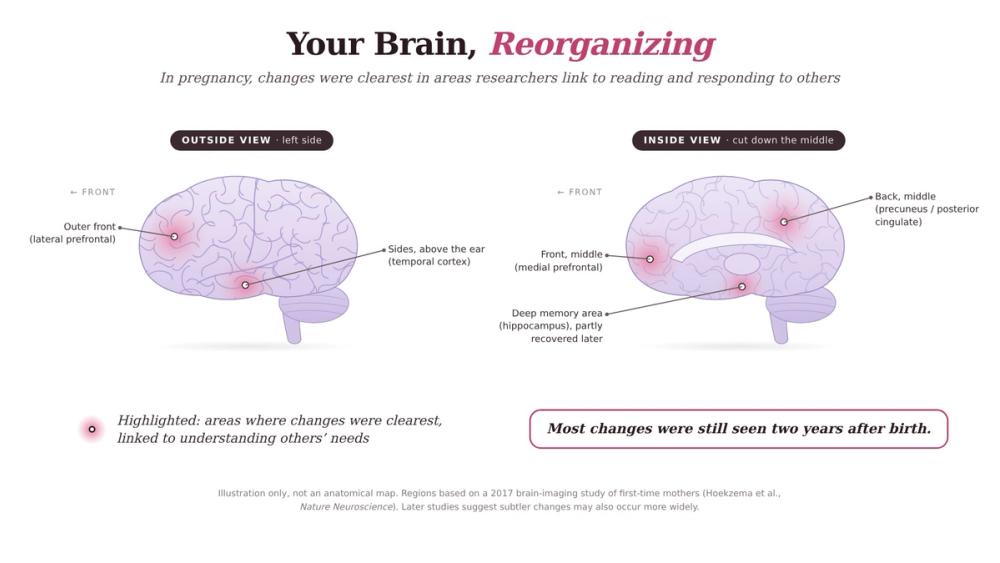
So yes, your brain is changing. But "changing" doesn't mean "getting worse." Some of what feels like fog may be your brain reorganizing around a new and very demanding job, often on very little sleep.
Try this: Take the pressure off your memory. Shared calendars, notes on your phone, and a running list on the fridge aren't signs you're slipping. They're tools for a brain that's managing a lot more than before.
Relationships: Everyone shifts a little
When my daughter arrived, it wasn't only my relationship with her that was new. My relationships with my husband, my friends, and my own family all shifted too.
Your partner.
Many couples are surprised by how much a baby changes their relationship. One study that followed couples over eight years found that relationship satisfaction tended to drop after the first child was born, and that the drop came more suddenly than for couples without children. [7] That isn't a prediction for your relationship. Less sleep, less time alone together, and new disagreements about who does what are common, and talking about them early helps.
Your friends.
Some friendships get closer. Others fade, especially with friends in a different stage of life. You may also find yourself looking for new people who understand your days, which surprised me as someone who'd always been so independent.
Your family.
Becoming a mother can change how you see your own mother and the way you were raised. It can bring new closeness, old hurts, or both. It can also mean setting boundaries you never needed before.
Try this: Choose one relationship that feels strained and plan one honest conversation. Not about everything, just one thing. "I've been feeling…" goes much further than "You never…"
Your body: Recovery takes longer than six weeks
The six-week checkup can make it feel like there's a finish line for recovery. For a lot of women, there isn't.
The American College of Obstetricians and Gynecologists recommends treating postpartum care as an ongoing process rather than a single visit. That includes checking in within the first three weeks and having a full visit no later than 12 weeks after birth. [8]
Your body may be healing from birth, adjusting to big hormonal changes, feeding a baby, and running on broken sleep, all at once. Pelvic floor changes, back pain, hair loss, night sweats, and changes in weight or shape are all common. So is feeling like your body doesn't quite belong to you, especially if you're breastfeeding or carrying a baby most of the day.
How you feel about your body can change too. Some women feel more respect for what their body did. Others feel disconnected from it. Many feel both.
Try this: Bring up physical symptoms with your provider, even ones that seem small or embarrassing, like leaking, pain during sex, or ongoing pain. "Common" doesn't always mean "nothing can be done." Pelvic floor physical therapists, for example, can help with many of these issues.
Your time and interests: What you want may change, and that's allowed
Before my daughter, my free time was mine. Afterward, "free time" meant the 20 minutes before she woke up, and I often spent it staring at my phone, wondering what I even liked anymore.
Many mothers find their interests shift. Some old hobbies fall away. New ones appear. And some things you still love are simply waiting until you have the time, energy, or childcare to get back to them.
This connects back to identity. Not having time for something doesn't mean it's no longer part of you.
Try this: Pick one small thing that's just for you, like ten minutes of reading, a walk without the stroller, or a class once a month. Protect it the way you'd protect a doctor's appointment. Small, regular time for yourself often matters more than an occasional big break.
You're not doing it wrong
If you're in the middle of this transition and feel unsure of who you are, that doesn't mean something has gone wrong. It may mean you're going through one of the biggest changes a person can go through, often without much guidance.
You can love your child and miss your old life. You can feel more confident and more lost at the same time. You can grow into motherhood and still be yourself.
The baby books prepare us for the baby. Nobody prepares us for ourselves. I hope this helps fill a little of that gap.
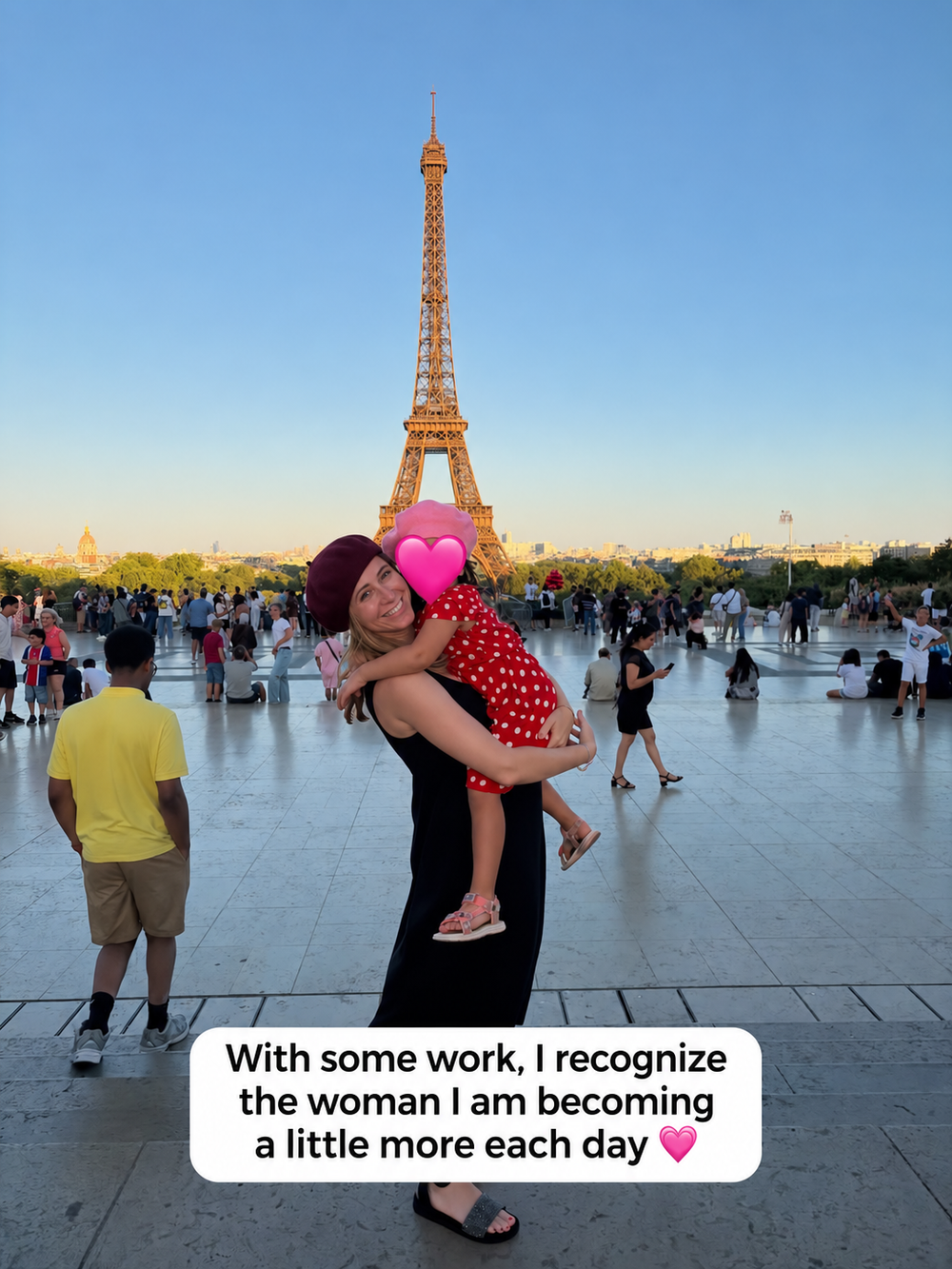
I wrote Still Her for the woman I was on that day in the doctor's office: someone who was ready for her baby but not for how much she herself would change. It explores each of these changes in more depth, along with ways to care for yourself through them. If this article spoke to you, you can find it below.
References
- Raphael, D. (1975). Matrescence, becoming a mother, a "new/old" rite de passage. In D. Raphael (Ed.), Being Female: Reproduction, Power, and Change. Mouton.
- Laney, E. K., Hall, M. E. L., Anderson, T. L., & Willingham, M. M. (2015). Becoming a mother: The influence of motherhood on women's identity development. Identity, 15(2), 126–145.
- American College of Obstetricians and Gynecologists. Postpartum Depression (patient FAQ).
- Centers for Disease Control and Prevention. Depression During and After Pregnancy.
- Hoekzema, E., et al. (2017). Pregnancy leads to long-lasting changes in human brain structure. Nature Neuroscience, 20, 287–296.
- Davies, S. J., Lum, J. A., Skouteris, H., Byrne, L. K., & Hayden, M. J. (2018). Cognitive impairment during pregnancy: A meta-analysis. Medical Journal of Australia, 208(1), 35–40.
- Doss, B. D., Rhoades, G. K., Stanley, S. M., & Markman, H. J. (2009). The effect of the transition to parenthood on relationship quality: An 8-year prospective study. Journal of Personality and Social Psychology, 96(3), 601–619.
- American College of Obstetricians and Gynecologists. (2018). Committee Opinion No. 736: Optimizing Postpartum Care. Obstetrics & Gynecology, 131(5), e140–e150.